

Next-Generation Firewall Market to Reach USD 13.38 Billion by 2032 as Cyber Threats Intensify
Rising cyberattacks, cloud migration, and remote work models accelerate demand for next-generation firewall solutions worldwide.
AI-enabled, cloud-ready firewalls are redefining enterprise cybersecurity as digital transformation accelerates globally.”
PUNE, MAHARASHTRA, INDIA, February 3, 2026 /EINPresswire.com/ -- Next-Generation Firewall Market Outlook Strengthens in 2026 and Beyond— Fortune Business Insights
The global next-generation firewall market 2026 is witnessing robust momentum as organizations worldwide strengthen cybersecurity defenses against increasingly complex and sophisticated threats. The surge in ransomware, phishing, zero-day attacks, and cloud-based vulnerabilities has accelerated the adoption of application-aware, AI-enabled firewall solutions across enterprises of all sizes.
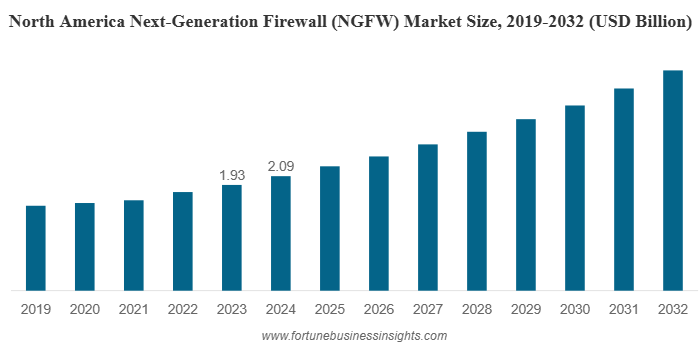
According to Fortune Business Insights, the global next-generation firewall (NGFW) market was valued at USD 5.82 billion in 2024 and is projected to grow from USD 6.40 billion in 2025 to USD 13.38 billion by 2032, registering a CAGR of 11.1% during the forecast period. North America led the market in 2024, accounting for 35.91% of total revenue, supported by early adoption of advanced cybersecurity technologies and strong regulatory frameworks.
Get Sample Report PDF:
https://www.fortunebusinessinsights.com/enquiry/request-sample-pdf/next-generation-firewall-market-112358
Market Snapshot: Next-Generation Firewall Market 2026
Market Value (2024): USD 5.82 Billion
Market Size (2025): USD 6.40 Billion
Forecast Value (2032): USD 13.38 Billion
Growth Rate: CAGR of 11.1% (2025–2032)
Leading Region: North America
Fastest-Growing Region: Asia Pacific
Dominant Component: Hardware
High-Growth Segment: Cloud-based NGFW Solutions
Market Overview: Advanced Cybersecurity Becomes Mission-Critical
Next-generation firewalls represent an evolution beyond traditional perimeter security, integrating deep packet inspection, application visibility and control, intrusion detection and prevention, and advanced threat protection into a single platform. These solutions operate at the application layer (Layer 7), enabling enterprises to identify and block sophisticated attacks that bypass conventional firewalls.
In the global next-generation firewall market 2026, demand is fueled by digital transformation, cloud migration, and the expansion of hybrid IT environments. Organizations now require unified security frameworks that provide visibility and policy enforcement across on-premises infrastructure, cloud workloads, and remote endpoints.
Key Market Drivers Accelerating Adoption
Rising Remote and Hybrid Work Environments
The shift toward remote and hybrid work has significantly expanded enterprise attack surfaces. Employees accessing corporate systems through unsecured home networks and personal devices have increased exposure to cyber threats. NGFW solutions address these risks by enabling secure VPN connectivity, identity-based access control, and zero-trust enforcement across distributed environments.
As hybrid work models become permanent across industries, enterprises are investing in scalable NGFW platforms that ensure consistent security policies regardless of user location.
Escalating Cyber Threat Landscape
The growing frequency and sophistication of cyberattacks are compelling organizations to replace legacy firewalls with intelligent, application-aware solutions. NGFWs leverage AI-driven analytics and real-time threat intelligence to detect anomalous behavior, block malware, and prevent data breaches, making them a cornerstone of modern cybersecurity strategies.
Impact of Generative AI on NGFW Solutions
Generative AI is transforming next-generation firewall capabilities by enabling predictive and adaptive threat detection. Unlike signature-based systems, AI-powered NGFWs analyze vast datasets to identify unknown malware variants and zero-day exploits.
By continuously learning from global threat intelligence and network behavior, generative AI enhances detection accuracy and response speed, allowing organizations to proactively defend against emerging attack vectors. This technological shift is expected to significantly strengthen enterprise cybersecurity posture throughout the forecast period.
Market Restraints Limiting Wider Adoption
High Initial Deployment and Upgrade Costs
Despite strong demand, the next-generation firewall market faces challenges related to high upfront costs. Deployment often requires significant investment in hardware appliances, software licenses, and professional integration services. For SMEs, recurring subscription fees and maintenance contracts can further increase total cost of ownership.
While cloud-based and subscription models are helping reduce capital expenditure, cost sensitivity remains a limiting factor in emerging markets.
Emerging Market Opportunities
Growing Adoption among SMEs and Emerging Economies
Small and medium-sized enterprises are rapidly digitizing operations, increasing exposure to cyber risks. Cloud-based NGFW and Firewall-as-a-Service (FWaaS) models provide enterprise-grade security without heavy infrastructure investment, making them attractive to budget-constrained organizations.
Vendors are increasingly targeting SMEs in Asia Pacific, Latin America, and Africa through managed security services and localized offerings, positioning this segment as a major growth engine in the global next-generation firewall market 2026.
Next-Generation Firewall Market Trends
Cloud Migration and Hybrid IT Security
The rapid adoption of cloud computing and hybrid IT architectures is reshaping cybersecurity strategies. NGFW vendors are introducing virtual and cloud-native firewalls that deliver unified visibility and policy enforcement across physical, virtual, and cloud environments.
These solutions enable seamless protection for applications and workloads moving between data centers and public clouds, driving strong demand for cloud-integrated NGFW platforms.
Regional Outlook Highlights
North America
North America remains the leading market due to early technology adoption, strong regulatory compliance requirements, and the presence of major cybersecurity vendors. High cyberattack frequency targeting critical infrastructure continues to drive NGFW investments.
Europe
Europe is witnessing steady growth supported by geopolitical cyber risks, strict data-protection regulations, and rising adoption of virtual firewalls aligned with sovereign-cloud requirements.
Asia Pacific
Asia Pacific is the fastest-growing region, driven by accelerated digitization, 5G deployment, and a large base of SMEs adopting subscription-based NGFW services to secure expanding digital operations.
Competitive Landscape Overview
The next-generation firewall market exhibits a semi-consolidated structure, with leading vendors focusing on AI-driven innovation, cloud security integration, and strategic partnerships. Continuous product enhancements and geographic expansion remain key strategies for maintaining competitive advantage.
Get Sample Report PDF:
https://www.fortunebusinessinsights.com/enquiry/request-sample-pdf/next-generation-firewall-market-112358
About Us
Fortune Business Insights provides in-depth market research and actionable intelligence to help businesses navigate industry transformation, uncover new opportunities, and make informed strategic decisions. Our reports combine verified data, expert analysis, and future forecasts to support sustainable growth, operational excellence, and long-term investment planning. Over the coming years, we will continue to expand our global coverage and strengthen our predictive analytics to help businesses adapt confidently to a rapidly changing energy landscape.
Ashwin Arora
Fortune Business Insights™ Pvt. Ltd.
+1 833-909-2966
sales@fortunebusinessinsights.com
Legal Disclaimer:
EIN Presswire provides this news content "as is" without warranty of any kind. We do not accept any responsibility or liability for the accuracy, content, images, videos, licenses, completeness, legality, or reliability of the information contained in this article. If you have any complaints or copyright issues related to this article, kindly contact the author above.
